
So What Does It Actually Take (and Cost) to Put PAM on Your Farm Road?
PAM for Farm Roads Series, Post 3 of 3
Part 1 – Dust Control
Part 2 – Rain & Erosion Resilience
We’ve spent two posts making the case for polyacrylamide (PAM) on farm roads — less dust, less mud, less erosion, fewer stuck trucks. All true, and all a bit theoretical until you get to the question that actually decides whether this happens on your farm. What does it take to put it down, and what’s it going to cost you compared to what you’re already spending?
Short answer: less equipment and hassle than you’d guess. And often less money over a season than the graveling and grading you’re already paying for. Longer answer below.
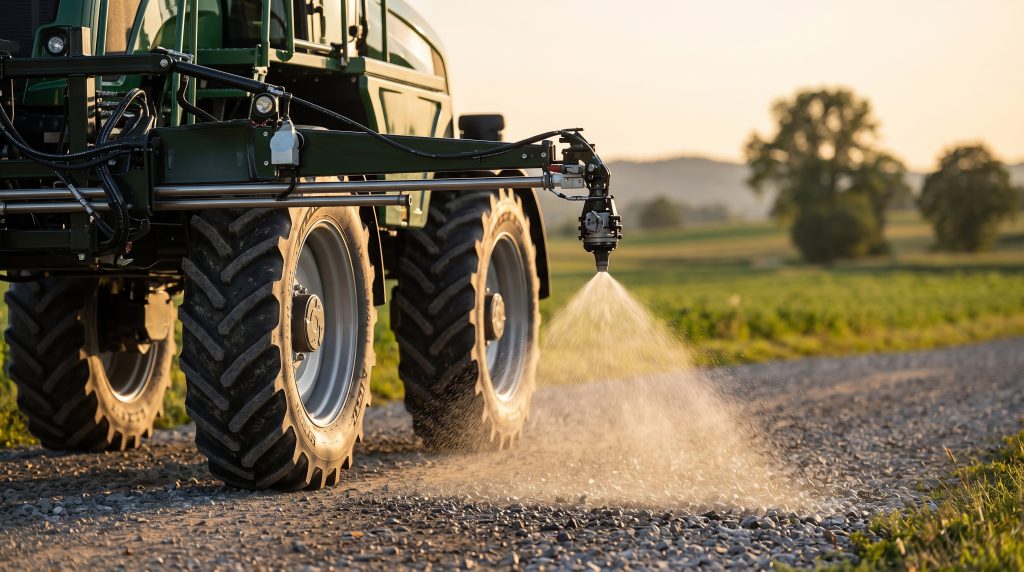
The whole operation, in one photo.The two ways it goes down
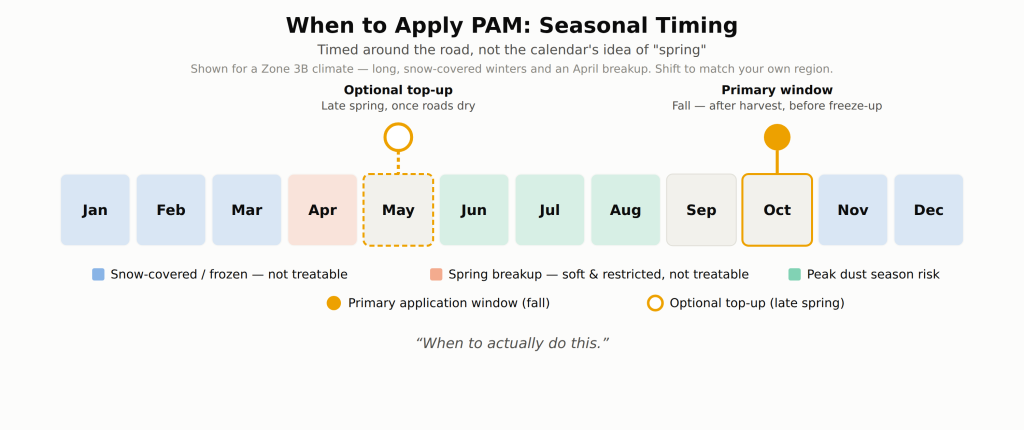
PAM for road stabilization typically comes in two forms: liquid (usually an emulsion, pre-mixed or diluted with water) and dry granular. For most farm road applications, liquid is the more common and more straightforward route. It’s sprayed onto the road surface using a water truck or tow-behind sprayer. The process is similar to applying a dust-suppressant product you may already be using. This just uses a different active ingredient and a different mechanism doing the work.
Granular PAM gets broadcast onto the surface and then watered in, either by rainfall or a follow-up pass with a water truck. It’s more common on larger-scale or construction applications where precise incorporation matters. But it’s a viable option for farm roads too. It can work particularly well during a regrading project, when you’re already reworking the surface and can mix it directly into the top few inches.
Either way, the road generally needs light surface prep first. Grade enough to knock down major ruts or washboarding. The treatment should go onto a reasonably even surface, not seal in existing damage.
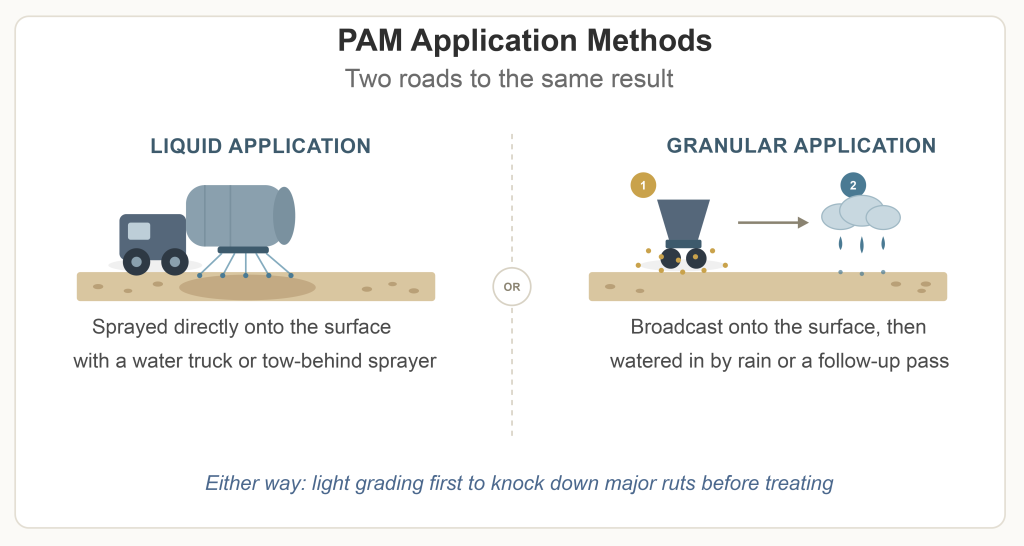
Roughly what it costs
Costs vary with product concentration, road width, and how badly the existing surface needs prep work first. As a general basis, PAM application for unpaved roads can range from a few hundred to around a thousand dollars per lane-mile. That includes materials and application. This is well below the cost of a full re-gravel. It can also be a fraction of what you’d spend over a season on repeated water-truck passes or salt-based dust suppressant reapplied every few weeks.
The honest framing: PAM isn’t “free maintenance forever”. It’s an input that reduces how often and how severely you need to grade, re-gravel, and dust-suppress. And it can pay for itself over a season or two through fewer maintenance passes and less material loss. The savings don’t usually come from one dramatic cost avoidance event.
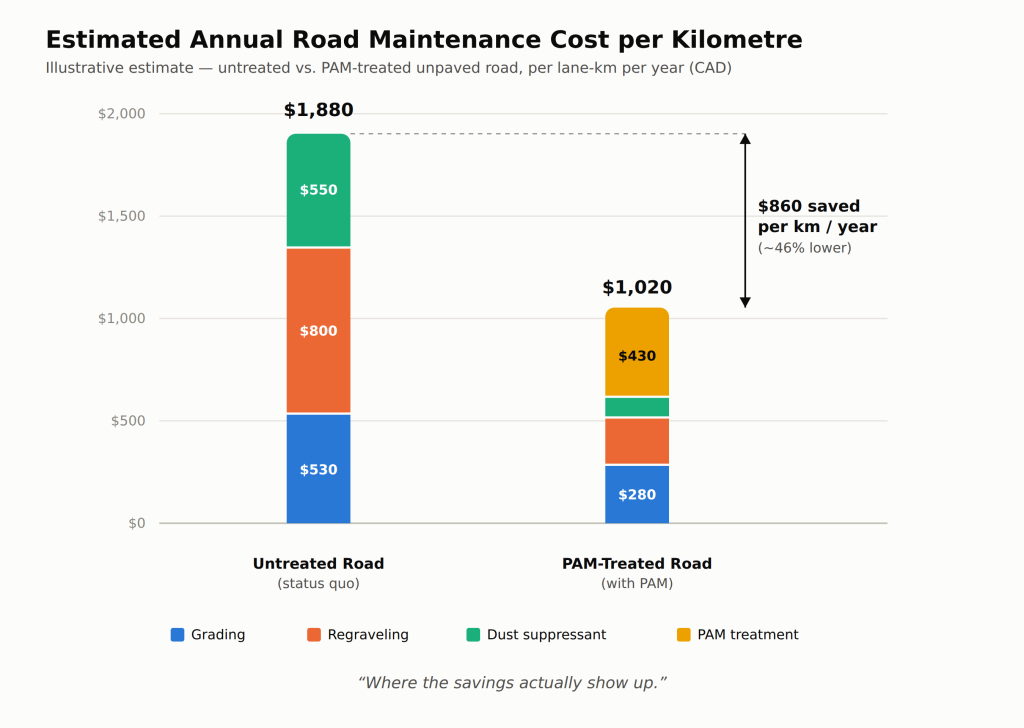
Timing and reapplication
Timing matters more than people expect. In a Zone 3B climate, “ahead of spring thaw” isn’t actually a real option. For a good chunk of the year, the road is under snow or frozen solid. Then, for a few weeks around breakup, it’s too soft and often weight-restricted for anything to drive on — let alone treat. There’s no bare, workable surface for PAM to bond to in either stretch.
The window that actually works is fall — after harvest traffic tapers off and before freeze-up. That gets the road stabilized going into winter. It comes out the other side of spring breakup already holding together, rather than starting from scratch once things thaw. A heavily trafficked stretch may need more support. A lighter top-up in late spring can help once the road has genuinely dried out — ahead of peak dust season.
How long a single application holds up depends on traffic volume and rainfall. But a well-applied treatment on a moderately trafficked farm road can provide meaningful benefit through a full season before needing a top-up. Heavily trafficked stretches will need more frequent attention. Think of the lane hit by every feed delivery and every piece of equipment moving between fields.
A word on safety, since it comes up
Anionic PAM, the type most commonly used for erosion control and road stabilization, has a long track record in agricultural and environmental applications. These applications include irrigation furrow treatment and erosion control blankets. Anionic PAM is generally regarded as low-toxicity when used according to label directions. The detail worth knowing is residual acrylamide monomer content. PAM is polymerized from acrylamide, and trace unreacted monomer is a legitimate consideration. This is why sourcing product with low residual monomer content and following labeled application rates matters. This isn’t a reason to avoid PAM; it’s a reason to buy from a supplier who can tell you their monomer numbers when you ask.
Putting the series together
Across these three posts:
PAM controls dust by binding fine soil particles at the surface so they don’t blow away (part one)
Controls mud and erosion by keeping those same particles bound together when saturated (part two)
And it does both through one relatively straightforward application. Over a season, that can cost less than the maintenance cycle it replaces.
It’s not a miracle fix for every road problem. A road with a genuine drainage or grading issue underneath still needs that fixed first. But for the everyday dust-and-mud cycle every unpaved farm road goes through, it’s a meaningfully better tool than water trucks and hope.
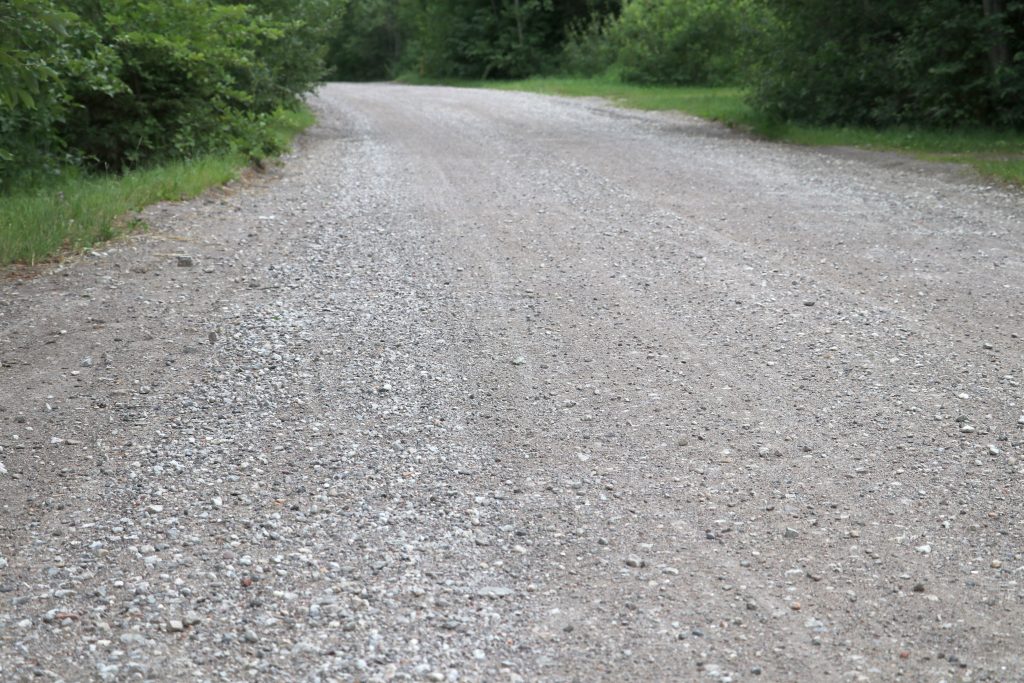
The road you actually wanted the whole time.If you want help figuring out the right product concentration and application plan for your specific road conditions, that’s exactly the kind of question worth a quick conversation before you buy anything.