
Your Farm Road Is Harming Your Truck’s Suspension (and Your Lungs)
Dust Control in Rural Alberta: PAM for Farm Roads Series, Post 1 of 3
Part 2 – Rain & Erosion Resilience
Part 3 – Application, Cost & Maintenance
Every farm has that road. The kilometre of gravel or dirt between the barn and the back forty that turns into a rooster tail of dust every time a truck, tractor, or ATV rolls down it. You’ve probably stopped noticing it, the same way you stop noticing a squeaky hinge. But your animals haven’t. Your equipment hasn’t. And if you’ve got crops growing anywhere near that road, they definitely haven’t. Maybe it’s time to consider an investment in dust control in rural Alberta.
Here’s the thing about dust: it’s not just an annoyance, it’s lost material. Every cloud kicked up by a passing wheel is topsoil, gravel fines, and road base leaving the road and going somewhere else — your lungs, your neighbor’s laundry line, or a fine gray film on the soybeans growing along the fence line. Do that a few thousand times a season and you’ve got a road that’s visibly thinner than it was five years ago, and a maintenance bill that keeps climbing to match.
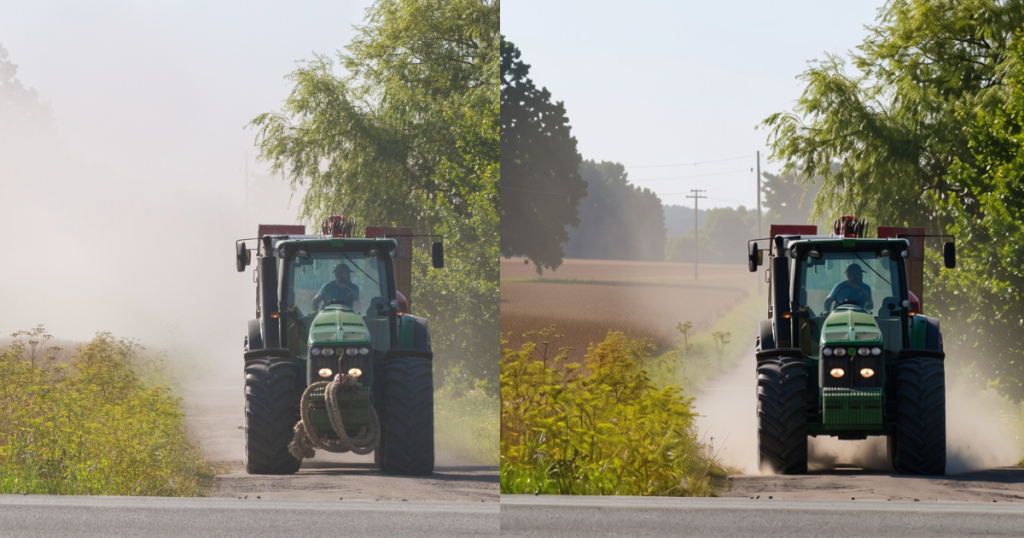
Same road, same truck, very different Tuesday.Why farm roads dust out in the first place
Unpaved roads are held together by fine particles — silt and clay — filling the gaps between larger gravel and rock. Traffic hammers that surface thousands of times a season, and every pass grinds those fines a little looser. Once they’re loose enough, wind and wheels lift them straight into the air. It’s basically the road surface disassembling itself, one tire pass at a time.
The usual fixes — water trucks, calcium chloride, more gravel — all work as dust control in rural Alberta, sort of, but can wear off fast. Water evaporates in an afternoon. Salt-based products pull moisture from the air only as long as there’s humidity to pull, and they’re brutal on equipment and roadside vegetation over time. Regraveling is a rinse-and-repeat expense that never actually solves the underlying problem, which is that the fines aren’t bound to anything.
Where PAM comes in
Polyacrylamide (PAM) takes a different approach: instead of fighting dust after it’s airborne, it stops the road from letting go of its fines in the first place. PAM is a long-chain, water-soluble polymer that, when applied to the road surface (usually as a liquid, sometimes granular and watered in), works its way into the top few inches and does something oddly elegant at the molecular level — it bridges between individual clay and silt particles, pulling them into larger, more stable aggregates that are heavier, harder to dislodge, and far more resistant to abrasion from tires.
Think of it as the difference between a pile of loose flour and a ball of dough. Same basic ingredients, wildly different behavior under pressure.
Because it’s binding at the particle level rather than sitting on top as a crust, a properly applied PAM treatment holds up through repeated traffic in a way that surface-only treatments don’t. Most farm operations see meaningfully reduced dust for a full season or longer between applications, depending on traffic volume and rainfall.
What that actually buys you
Dust control in rural Alberta on the road means less dust on the crops growing next to it — and that matters more than people assume. A visible coating of road dust on plant leaves blocks light and clogs stomata, and studies on roadside crop yields have shown measurable reductions in photosynthesis and yield within the first several meters of an untreated dirt or gravel road. If you’ve got a market garden, orchard, or hay field bordering your farm road, that dust is a line item you didn’t know you had.
It also means less abrasive grit working its way into engine air filters, bearings, and hydraulic seals on everything from the feed truck to the combine — dust is genuinely hard on machinery, and unpaved road dust is one of the more preventable sources of it. And for anyone working outdoors near that road for hours at a stretch, whether that’s you, a hired hand, or the livestock standing in a dry lot next to it, less airborne particulate is just a healthier place to breathe.
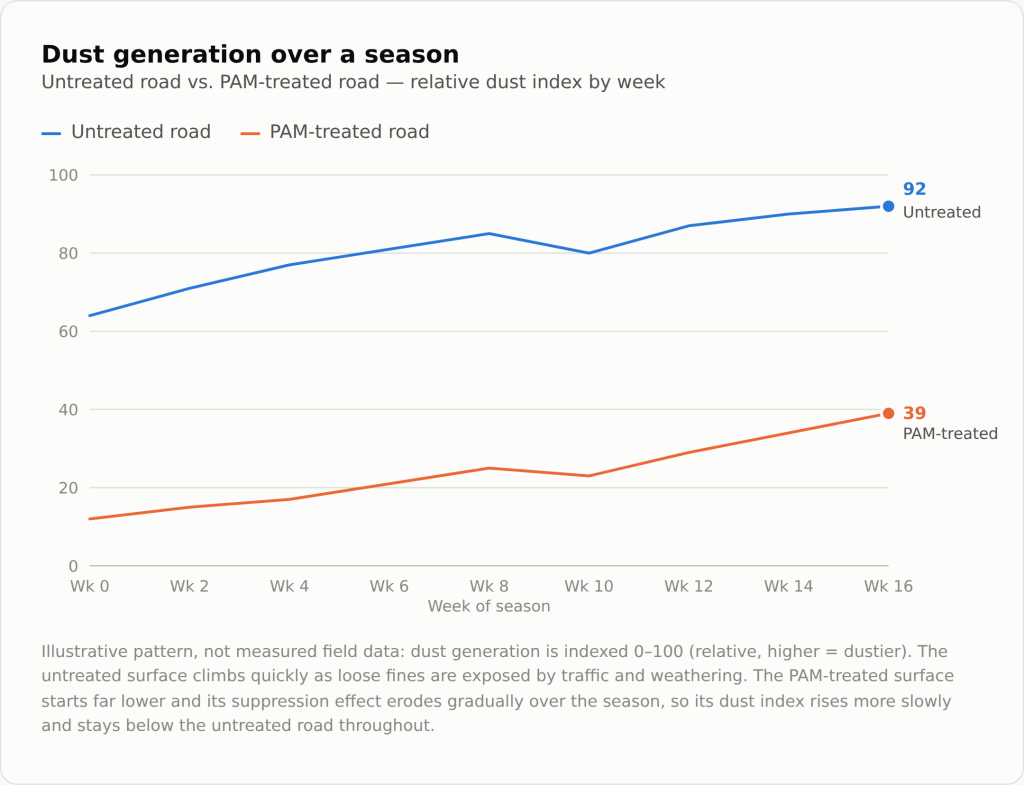
A quick real-world picture
Picture a kilometre-long gravel lane connecting a hay barn to the county road, running 15–20 truck and tractor passes a day during hay season. Untreated, that road is visibly dusting by mid-morning on a dry day, and the hay stacked along one side ends up with a gray cast that buyers notice. Treated with PAM at the start of the season, the same traffic produces a fraction of the airborne dust, and the difference is obvious enough that neighbors ask what changed.
The bottom line
Dust control in rural Alberta isn’t just about curb appeal for a road nobody but you drives on. It’s soil retention, equipment longevity, crop protection, and a genuinely better place to work and raise animals. PAM doesn’t make the dust disappear by magic — it just stops your road from falling apart one gray cloud at a time.
Up next in this series: what happens to that same road come spring thaw and rainy season, and how the same polymer that’s fighting your dust problem also fights your mud problem.
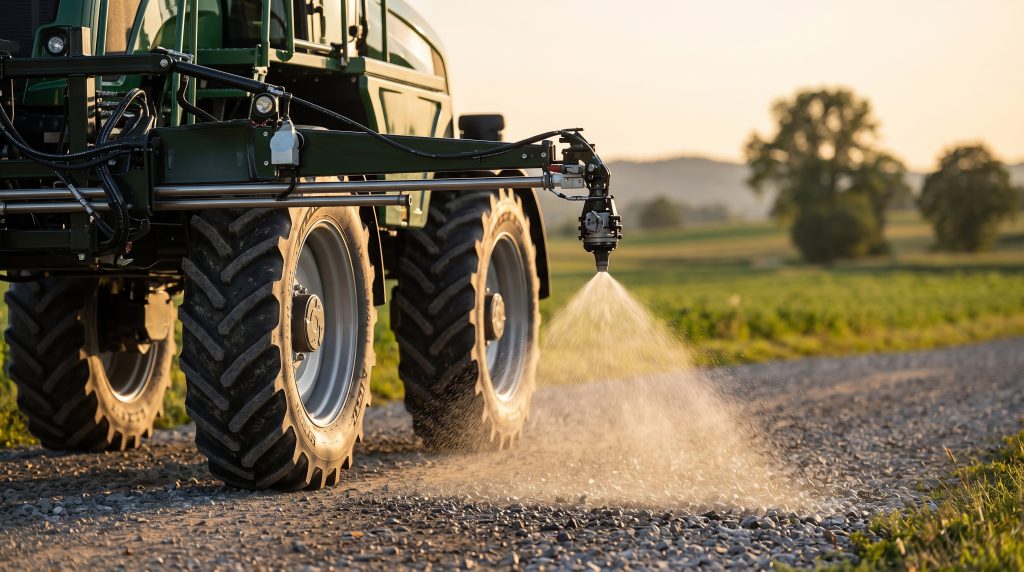
The application step — more spray truck, less rocket science.