
Why Your Wash Pond Won’t Clear Up (and how PAM can assist).
Sand washing water clarification sounds like a simple checkbox. In reality, it’s the step that decides whether your plant reuses water or keeps buying more of it. Raw sand goes into the wash circuit caked in silt and clay, and clean sand comes out. The water that did the scrubbing, however, often comes out looking like chocolate milk. In a settling pond, it can stay cloudy for days without help. That’s not a housekeeping problem.
It’s a sign that your fine solids aren’t separating effectively, and your bottom line is paying for it.
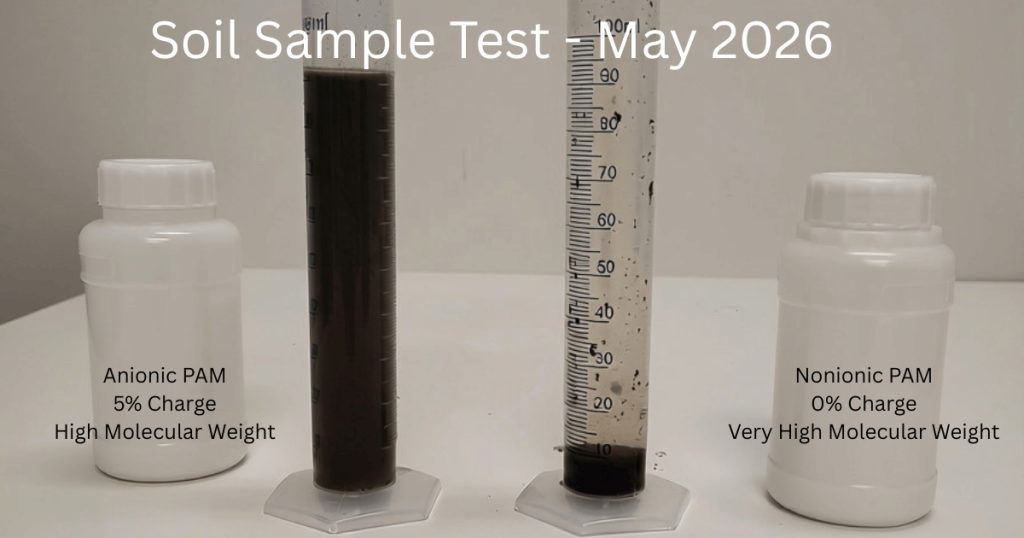
Why Won’t the Fines Settle on Their Own?
The fines causing the trouble can be extremely small, particularly the silt- and clay-sized particles. Many of these fine mineral and clay particles carry a negative surface charge. Because like charges repel, the particles can resist clumping together instead of forming larger aggregates. At very small particle sizes, Brownian motion and surface-charge effects can keep particles suspended, making gravity alone a slow and unreliable way to clarify the water.
This is exactly why sand washing water clarification can need a chemical assist, not just more time.
What Sand Washing Water Clarification with PAM Actually Does
Polyacrylamide, or PAM, is a flocculant. It primarily works by bridging particles together. A long polymer chain attaches to particles and helps bring several particles together. More particles become connected, forming larger, heavier flocs. Depending on the polymer type and water chemistry, electrostatic interactions can also play a role.
Those larger flocs can settle much faster than the individual fine particles. That’s the core of sand washing water clarification with PAM: turn tiny, stubborn particles into big, cooperative ones.
Plants use PAM in several ways. Some dose it straight into the thickener feed as a stand-alone flocculant. Others pair it with a coagulant first, such as alum, ferric chloride, or a suitable cationic polymer. Coagulation can destabilize fine particles, while PAM then helps bridge them into larger flocs. Whether a coagulant is needed depends on the characteristics of the water and solids.
This two-step method can work well when the solids are particularly difficult to destabilize or when additional coagulation is needed before flocculation.
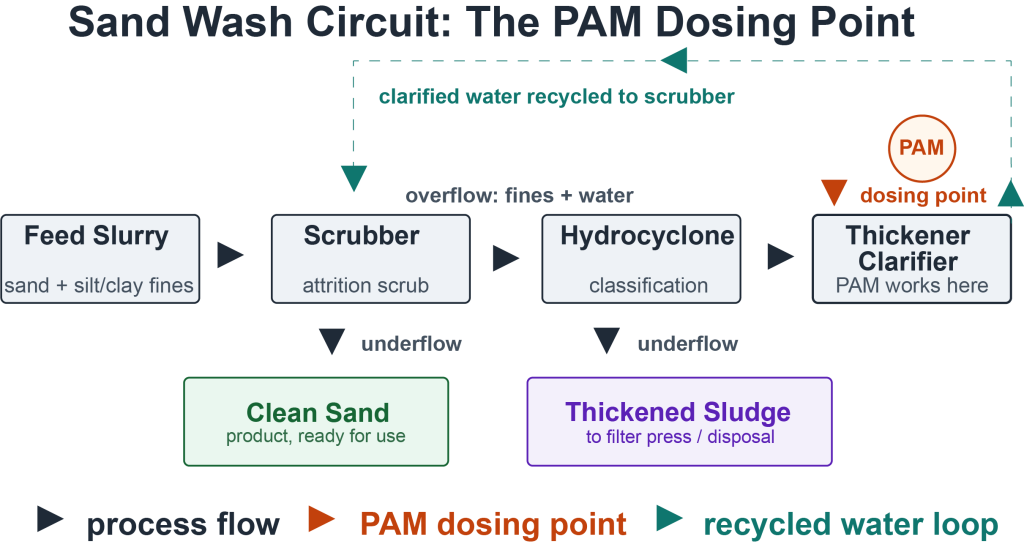
One dosing point, a lot less pond.Why Dosing Is the Part That Takes Real Engineering
Not every PAM performs the same way on every site. Charge type and molecular weight both affect how well the polymer bridges your specific fines. So does mixing energy. Water pH, hardness, and temperature matter too, since each can affect polymer performance and interactions with the particles.
Too little mixing, and the flocs may never form properly. Too much shear afterward, and you can break the flocs back apart. That often looks like “the polymer isn’t working,” when really, it worked, and then an oversized pump or excessive shear damaged the flocs.
Overdosing causes its own problems, too. Add too much polymer, and flocculation performance can decline, while floc structure and settling characteristics may deteriorate.. Underdosing just brings you back to square one.
This is why jar testing matters so much before scaling up. It’s a lot cheaper to learn the right dose in a sample batch or jar test. Guessing on a full load costs far more, in both wasted polymer and lost production time.
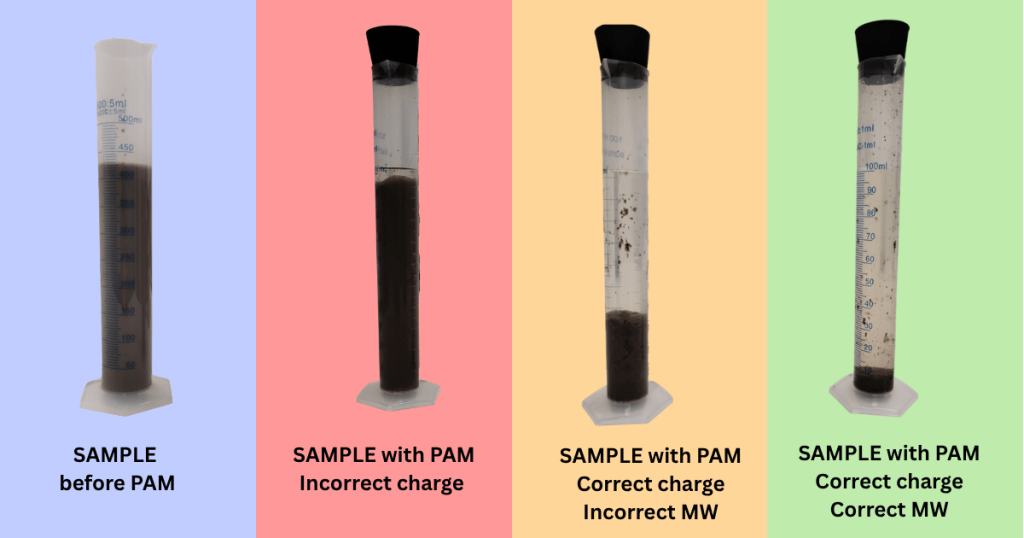
Jar testing ensures that the right ionic charge, molecular weight and dose are used for the specific effluent being treated. MW - Molecular Weight.A Quick Example
Picture a mid-size sand and gravel operation running two settling ponds in rotation. One is always still cloudy when the other fills up. That’s a common challenge in operations where fine solids settle slowly.
Now imagine the operation tests several PAM formulations against a sample of its actual wash water. The testing identifies a polymer and dose that produces larger, faster-settling flocs.
Instead of relying entirely on long settling times, the operation may be able to improve clarification, increase the amount of water available for reuse, and reduce the pressure on its settling ponds.
The exact results will depend on the characteristics of the fines, water chemistry, polymer selection, dose, mixing, and the design of the water-management system.
That’s why jar testing matters. The goal isn’t to find a generic “best” PAM. It’s to find the polymer and operating conditions that work for your water.
What Good Sand Washing Water Clarification Buys You
Done right, PAM-driven sand washing water clarification can significantly accelerate settling compared with relying on gravity alone.. That upgrade can pay off in several ways.
First, water reuse can improve significantly. Depending on the process and water-management system, improved clarification can allow plants to recover a substantial portion of their process water for reuse.
Second, the required settling capacity may be reduced. A system that previously relied on days of settling may be able to achieve the required clarification more quickly with the right polymer and process design.That can reduce the need for additional settling capacity just to keep up with production.
Third, compliance can become easier. Where discharge is permitted, water-quality requirements can make effective solids removal and clarification critical to compliance. A well-designed and properly dosed flocculant program can help reduce suspended solids and turbidity.
It’s the gap between meeting your water-quality requirements comfortably and scrambling whenever compliance staff pull a sample. That’s the kind of margin worth having before an inspector shows up, not after.
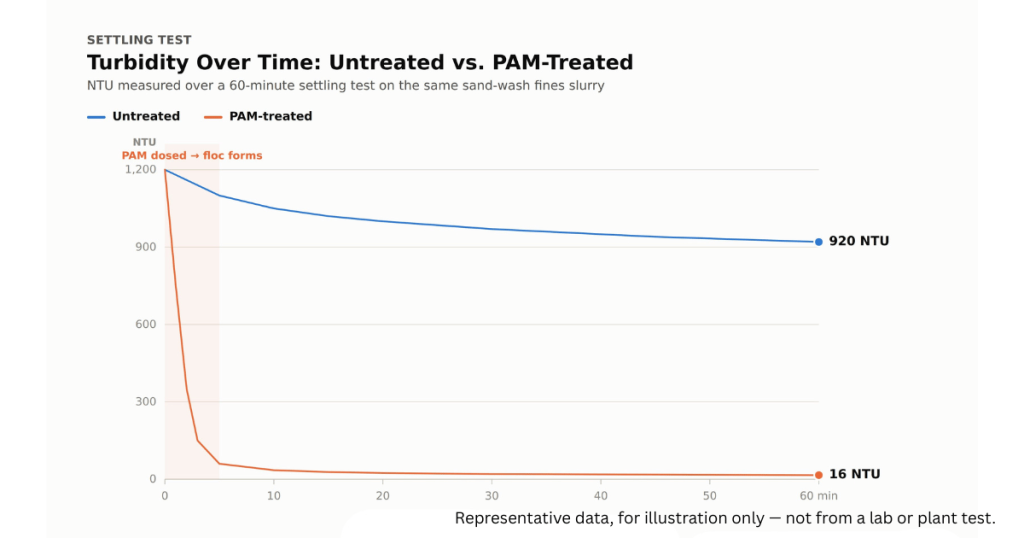
Illustrative example: PAM-assisted flocculation can accelerate clarification
Get Your Dose Right, Not Just Your Chemistry
None of this works from a datasheet alone. Getting from “PAM helps” to the right dose for your specific fines takes real jar-testing and process-optimization work. Skip that step, and you’re just guessing with more expensive tools, and expensive guesses tend to repeat themselves.
If your settling ponds take longer to clarify than your schedule allows, the cause may be polymer selection, dosing, mixing, solids loading, or pond hydraulics. It’s rarely a simple “buy more polymer” problem.
Polychem Solutions helps sand, aggregate, and mineral processing operations dial in their sand washing water clarification process. We work from bench testing through full-scale plant results. That way, the dose that works in the jar still works in the thickener.
Get in touch, and we’ll take a look at your fines.